Smart Door Locks: A Simple Guide to Modern Home Security
Smart door locks combine electronic access methods with traditional locking mechanisms to provide convenient, connected access and better visibility over door activity.
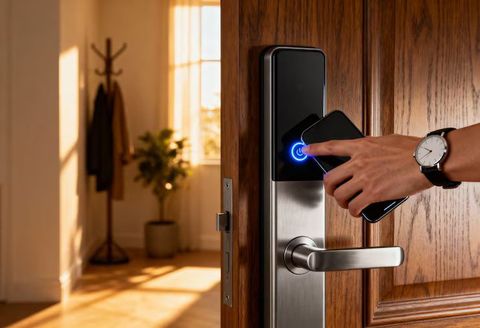
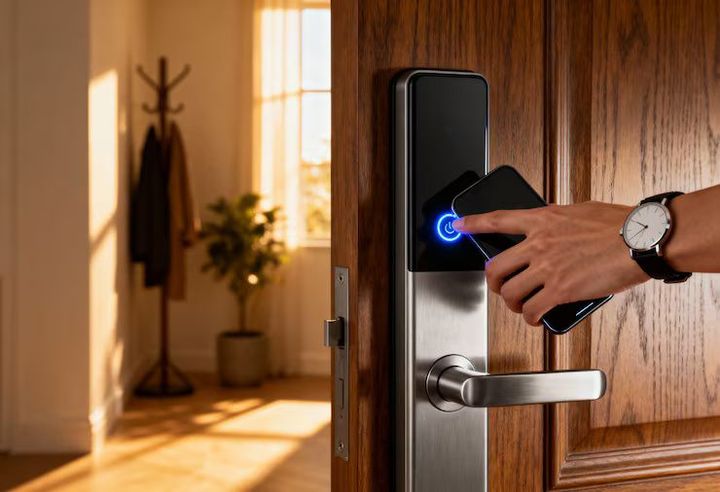
Smart door locks are electronic locking systems that can control access using methods such as PIN codes, fingerprints, smartphones, key cards, Bluetooth, or other digital authentication technologies. Some models also retain a physical key or mechanical override for situations such as battery depletion.
The technology developed from traditional mechanical locks toward electronic access control, biometric authentication, and smart home security systems. Depending on the design, a lock may communicate through Bluetooth, Wi-Fi, Zigbee, Z-Wave, or another wireless protocol.
Smart locks are increasingly associated with residential security, apartments, offices, hospitality properties, and connected buildings. Market research published in 2026 indicates continuing growth in India's smart-lock sector, although estimates vary considerably between research firms because of different market definitions and methodologies.
Common Smart Lock Technologies
| Technology | Typical function |
|---|---|
| PIN keypad | Entry using a programmed code |
| Fingerprint | Biometric authentication |
| Smartphone | Digital access through an application |
| RFID/NFC | Entry using compatible cards or devices |
| Bluetooth | Local wireless communication |
| Wi-Fi | Remote connectivity where supported |
| Mechanical key | Backup access on selected models |
Why Smart Locks Matter Today
Modern access control is increasingly connected to the Internet of Things (IoT) and smart-home technology. This allows users to manage digital credentials and, on compatible systems, review access activity from a connected device.
Smart locks can address several practical problems. For example, households may prefer keyless entry, while property managers can use individual credentials rather than distributing physical keys.
They can also support temporary or scheduled credentials, depending on the system. However, digital access should not be treated as automatically more secure than a conventional lock. Security depends on the lock's physical construction, authentication system, software, network configuration, and user practices.
The Indian market is seeing greater interest in Bluetooth, Wi-Fi, biometric and IoT-connected locking technologies. Recent market analyses also identify residential and commercial applications as important segments.
Security Considerations
Users should consider:
- Strong PINs rather than easily guessed numbers
- Regular firmware and application updates
- Secure home Wi-Fi configurations
- Reliable battery monitoring
- A suitable mechanical backup mechanism
- Protection of smartphone and account credentials
- Whether access logs are stored locally or through cloud infrastructure
Recent Developments and Trends
During 2025 and 2026, smart-lock discussions increasingly focused on biometric access control, smartphone authentication, IoT integration, wireless connectivity, and smart-home interoperability. Market research updated during 2026 continues to identify Bluetooth and Wi-Fi connectivity as important technologies.
Another development is the broader movement toward electronic locking standards. In June 2026, a Bureau of Indian Standards work document listed IS 19461:2025, Electronic Locks for Security Equipment — Specifications, among standards in its security-equipment portfolio. This is relevant to the broader electronic-lock ecosystem, although it should not automatically be interpreted as a certification requirement for every residential smart door lock.
Industry reporting in December 2025 also described increasing adoption of digital locks in India's residential and urban markets.
Laws, Standards, and Policies in India
Smart door locks can intersect with several areas of Indian regulation, including product standards, wireless communication requirements, consumer protection, and data protection.
The Bureau of Indian Standards (BIS) provides a searchable database where users can check applicable Indian Standards, amendments, testing information, and related certification details. BIS explains that manufacturers seeking certification first identify the relevant Indian Standard and then demonstrate conformity through assessment and testing.
For connected locks, wireless communication and digital-data considerations may also be relevant. The exact requirements depend on the device's technical characteristics and intended use. Users should therefore check the applicable Indian requirements for a specific product rather than assuming that one standard applies to every smart lock.
Tools and Resources for Smart Lock Research
Useful resources include:
- BIS standards databases for checking applicable Indian Standards
- Product manuals for installation and emergency-access procedures
- Wireless-network diagnostic tools for checking home connectivity
- Battery-monitoring features within compatible lock applications
- Access-control logs for reviewing authorized entry activity
- Security checklists for evaluating passwords, authentication and updates
- Manufacturer firmware documentation for understanding software-update procedures
A useful comparison table can evaluate authentication method, connectivity, backup access, battery type, physical lock construction, privacy controls, and compatibility with existing doors.
FAQs
Are smart door locks completely secure?
No locking technology can guarantee complete security. Protection depends on both physical resistance and digital security, including authentication, software updates and network configuration.
Can a smart lock work without Wi-Fi?
Some can. Bluetooth-based and locally controlled systems may continue to provide access without an internet connection. Features requiring remote connectivity may not work when internet access is unavailable.
What happens if the battery runs out?
The procedure depends on the model. Some systems provide emergency power contacts, mechanical keys, replaceable batteries, or other backup mechanisms.
Are biometric smart locks reliable?
Fingerprint and other biometric systems can provide convenient authentication, but recognition performance can vary with the sensor, installation, environmental conditions and user's biometric characteristics.
Should smart locks be connected to a smart-home system?
Integration is optional. It can provide additional automation and monitoring, but users should evaluate compatibility, privacy settings and cybersecurity requirements before connecting devices.
Conclusion
Smart door locks represent the convergence of physical security, electronic access control, biometric authentication and IoT technology. Their main advantages can include keyless access, credential management and connectivity, while their limitations include battery dependence, software risks and compatibility considerations.
For Indian users, understanding the physical lock, authentication method, wireless technology, backup access and applicable standards is more important than focusing on a single feature. A balanced security approach combines appropriate hardware with careful digital-security practices.
Disclaimer
This article is for general educational purposes and does not constitute legal, cybersecurity, engineering, or security advice. Applicable standards and regulations can change, so specific compliance questions should be checked against current official requirements.